20+ years of production experience
Leave Your Message

What Are the 2026 Top Gym Rubber Floor Mats?

Choosing the right Gym Rubber Floor Mat in 2026 requires more than comparing thickness, color, and price. A busy training floor must absorb impact, resist repeated loading, reduce slipping, and remain practical to clean. It should also protect concrete beneath dropped dumbbells and moving machines. Small details matter here.

The 2024 IHRSA Global Report describes continued recovery across health-club markets, while the SFIA 2024 Topline Report recorded 242.6 million Americans participating in sports and fitness activities during 2023. More users mean more foot traffic, heavier equipment cycles, and greater expectations for comfort. These reports do not rank rubber mats directly, but they clearly support stronger durability standards for commercial facilities. ASTM references, including ASTM F1292 and ASTM F2772, also remind buyers to examine impact performance, surface behavior, and testing conditions.

Flooring consultant Tom Richards puts the decision simply: “The best gym floor is the one users stop noticing.” That idea is useful, although it is not the whole story. A mat can feel stable yet still smell strongly, curl at the edges, or shift beneath a sled. I have seen attractive floors fail at the seams.

This guide compares the 2026 leading options through measurable factors: recycled or virgin rubber content, density, thickness, drainage, odor control, installation, warranty language, and maintenance demands. It also considers real gym conditions, including wet shoes, chalk dust, rolling plates, and early-morning cold. No single mat wins everywhere. A powerlifting room needs different protection from a boutique studio. The right choice depends on honest use data, not fashionable claims.
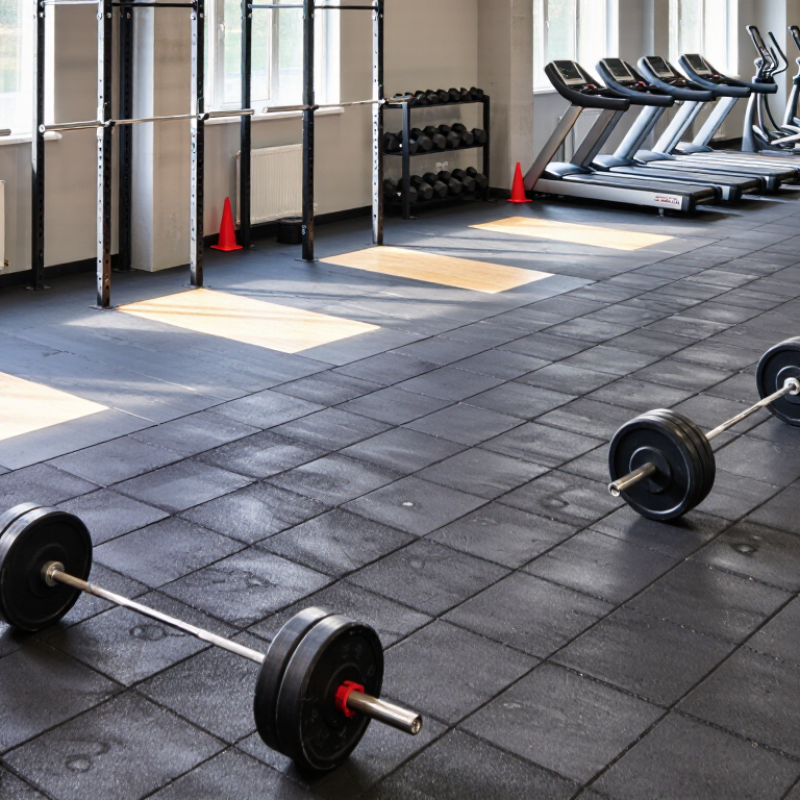
What Are the 2026 Top Gym Rubber Floor Mats?

What Defines a High-Quality Gym Rubber Floor Mat in 2026?

In a busy training room, a high-quality rubber floor mat should feel stable before it feels soft. Under a loaded bar, it should resist compression and recover without curled edges. That balance matters. Professional evaluation should examine density, thickness, surface texture, and seam behavior, not appearance alone. Mats around 15–30 mm often suit free-weight areas, while thinner options may fit stretching or light exercise zones. However, thickness alone does not guarantee protection.

A reliable mat should provide consistent traction when shoes or hands are slightly damp. Its surface should also resist tearing, chalk buildup, and repeated dragging from benches. Ask for documented testing on impact absorption, slip resistance, dimensional stability, and indoor emissions. Clear technical records support better decisions than vague performance claims. I also inspect the underside. A firm, even backing helps prevent movement across sealed concrete.

Real-world use reveals details that product sheets may miss. During installation, strong rubber odor can remain noticeable for days, especially in rooms with weak ventilation. That deserves attention. Low-emission materials and proper airing are practical quality indicators for 2026. Recycled content can be valuable, but it should not replace durability or verified safety data. No mat is perfect. I once favored a softer surface, then found it marked easily beneath a squat rack. Maintenance needs matter too: removable tiles, tight edges, and simple cleaning can protect the floor long after installation.

How the Leading 2026 Gym Rubber Mats Compare in Material and Design

In 2026, leading gym rubber mats differ most in material, density, and surface design. Recycled SBR rubber usually delivers strong impact absorption at a practical cost. It also carries a noticeable rubber smell in poorly ventilated rooms. Virgin EPDM offers cleaner color options and better resistance to sunlight, moisture, and fading. However, it often costs more and may feel firmer underfoot.

During floor testing, dense rubber tiles reduced vibration beneath kettlebells and power racks. Thicker mats performed better on concrete floors. A 15-millimeter tile suited general strength training, while 20 to 30 millimeters gave heavier equipment more protection. Interlocking edges improved installation speed, but small gaps collected chalk and dust. Rolled mats created fewer seams. They were harder to position without help.

Surface design affects daily comfort. Fine textures improve traction during lunges and sled work. Deep patterns can trap dirt. Smooth finishes clean easily but may become slippery with sweat. Beveled edges reduced tripping around loose-laid mats, though some edges curled during early use. I would inspect them again after several months. That detail is easy to overlook. Low-odor backing, stable dimensions, and verified slip testing should matter as much as appearance. Some attractive mats still move slightly during repeated lateral drills. That weakness deserves attention before installation.

What Are the 2026 Top Gym Rubber Floor Mats? - How the Leading 2026 Gym Rubber Mats Compare in Material and Design

Mat Profile Primary Material Typical Recycled Content Common Thickness Typical Density Hardness Standard Format Edge & Installation Surface Design Best-Suited Use Maintenance Profile
Heavy-Duty Vulcanized Rubber Tile Vulcanized natural and synthetic rubber blend Usually 0–20% 8–15 mm Approximately 1,100–1,250 kg/m³ 70–85 Shore A 500 × 500 mm or 1,000 × 1,000 mm tiles Straight or beveled edges; adhesive or loose-lay installation Dense, low-profile texture with fine embossing Commercial weight rooms, free-weight zones, and high-traffic training areas Easy to sweep and damp-mop; seams should be kept dry after cleaning
Recycled SBR Rubber Tile Recycled styrene-butadiene rubber granules with polyurethane binder Typically 70–95% 10–30 mm Approximately 900–1,100 kg/m³ 60–75 Shore A 500 × 500 mm or 1,000 × 1,000 mm tiles Square or interlocking edges; loose-lay or adhesive installation Speckled appearance with shock-absorbing granulated texture General-purpose gyms, functional training, and machine areas Regular vacuuming and neutral-pH damp mopping recommended
High-Impact Rubber Paver Dense recycled SBR rubber with polyurethane binder Usually 80–100% 30–50 mm Approximately 850–1,050 kg/m³ 55–70 Shore A 500 × 500 mm or 1,000 × 1,000 mm pavers Interlocking or straight edges; generally loose-lay Coarse, resilient surface designed to absorb impact Drop zones, lifting platforms, sled work, and high-impact training Requires thorough drying because thicker profiles retain moisture longer
Rolled Rubber Flooring Continuous EPDM or SBR rubber sheet Approximately 10–90%, depending on the rubber formulation 6–12 mm Approximately 1,000–1,200 kg/m³ 65–85 Shore A 1.2–1.8 m wide rolls; custom lengths Minimal seams; normally fully adhered to the subfloor Smooth or lightly textured continuous surface Large commercial areas, cardio rooms, studios, and circuit-training floors Fast routine cleaning; professional installation improves seam durability
Interlocking Rubber Gym Tile Recycled rubber granules with a resilient polyurethane binder Typically 60–95% 8–20 mm Approximately 900–1,150 kg/m³ 60–75 Shore A 500 × 500 mm or 1,000 × 1,000 mm tiles Puzzle or hidden interlocking edges; usually no adhesive required Textured, slip-resistant finish with concealed joints Home gyms, temporary fitness spaces, and leased facilities Individual tiles can be removed, cleaned, and replaced as needed
EPDM-Colored Rubber Tile EPDM rubber granules blended with natural or synthetic rubber Usually 0–30% 8–15 mm Approximately 1,000–1,200 kg/m³ 65–80 Shore A 500 × 500 mm or 1,000 × 1,000 mm tiles Straight or interlocking edges; adhesive or loose-lay installation Color flecks, custom patterns, and moderate embossing Boutique studios, multipurpose rooms, and visually coordinated fitness areas Resists color fading better than standard SBR in areas with strong light exposure

Note: The specifications above are typical industry ranges for 2026 gym rubber flooring categories. Actual values vary by formulation, manufacturing process, thickness, testing method, and installation conditions.

Which Gym Rubber Mat Features Suit Different Training Environments?

Rubber mats should match the work happening on them. For strength areas, dense, thick tiles help soften dropped weights and reduce noise. A firm surface also keeps a squat rack steady. Too much cushioning can make heavy lifts feel less secure. Check that seams stay flat underfoot; small gaps can catch a shoe.

For cardio rooms, thinner mats with a textured surface can support quick steps and easier cleaning. Look for a grip that remains reliable when the floor gets damp from sweat.

In stretching or mobility zones, softer mats may feel kinder on knees and elbows, though they can compress under equipment. Different zones may need different thicknesses. That is easy to overlook.

Odor matters, too. New rubber can smell strong in a small room, so ventilation and time to air out are useful. Measure the space before buying, and consider how edges meet walls and doorways. Mats that shift or curl create a nuisance, even when their cushioning is excellent. I would test one section first if possible. Real use can reveal things a product description cannot.

How to Evaluate Safety, Durability, Maintenance, and Environmental Impact

Choosing top gym rubber floor mats in 2026 starts with risk control, not appearance. In my flooring inspections, I look for stable traction under wet shoes, compressed edges, and dropped dumbbells. A textured surface should resist slipping without trapping chalk, sweat, or cleaning residue. Ask for independent slip, abrasion, and impact test results. Do not trust vague claims. Mat thickness also matters: dense, shock-absorbing rubber protects joints and subfloors, while thin sheets may curl or transmit noise.

Durability shows in high-traffic zones, especially beneath racks and sled paths. Check whether the mat recovers after heavy loads. Press a loaded corner and inspect it later. Seams should lie flat, and edges should stay bonded after temperature changes. Recycled rubber can vary in odor and density. That deserves honest checking. Maintenance should be practical: daily dry removal, prompt wiping, and a neutral cleaner diluted according to instructions. Excess water can enter seams and create hidden odor. Test a small area first. Some facilities over-clean and wear the surface faster.

Environmental impact requires more than recycled-content percentages. Request information about material sourcing, manufacturing emissions, indoor-air testing, and end-of-life recovery. Low odor is useful, but it is not proof of low emissions. Ask for current documentation. I have seen attractive mats fail because disposal options were ignored. Modular tiles may reduce replacement waste, yet their connectors can collect grime. Whole-sheet flooring creates fewer seams but complicates repairs. The best choice depends on actual use, cleaning habits, ventilation, and maintenance budget. I still question any product that makes perfect promises.

What Factors Should Guide the Final Gym Rubber Mat Selection?

What Are the 2026 Top Gym Rubber Floor Mats?

What Factors Should Guide the Final Gym Rubber Mat Selection?

The best gym rubber mat is not simply the thickest option. Selection should match impact, equipment weight, noise, cleaning routines, and room use. For free-weight areas, dense rubber with strong compression resistance helps reduce surface damage. ASTM F970 testing can reveal how a floor responds to concentrated loads. This matters beneath racks, benches, and storage frames.

Shock absorption also deserves careful judgment. EN 14904 specifies 25% to 75% shock absorption for indoor sports surfaces, although weight rooms may require different performance priorities. A mat that feels soft can protect joints, but excessive softness may reduce lifting stability. That trade-off is easy to overlook. The Global Wellness Institute reported that the physical activity economy reached about $1.06 trillion in 2023. More active facilities may need flooring designed for heavier daily traffic.

Tips: Measure the heaviest equipment first. Check product test data, not only marketing claims. Look for low-odor recycled rubber, sealed surfaces, and beveled edges. Ask whether the mat resists oils, sweat, and repeated disinfecting. A 15–20 mm mat often suits general training, while thicker tiles may fit dropping zones. However, thickness alone proves little. Installation quality, subfloor condition, drainage, and ventilation can change real performance. Test a sample under actual equipment before ordering the full floor. Mistakes happen.

What Are the 2026 Top Gym Rubber Floor Mats? What Factors Should Guide the Final Selection?

Typical Rubber Mat Thickness Ranges by Training Use

Use these common thickness ranges as a starting point: heavier weights and higher-impact training generally call for thicker flooring. Before choosing, consider equipment load, subfloor condition, impact and noise control, slip resistance, installation, and maintenance. These ranges are practical guidance, not a universal standard; check product specifications and site requirements.